11+ Square and Cube Numbers: Powers, Roots and Questions
Understand square and cube numbers, inverse roots and common power mistakes with original worked practice.
The small 2 in 7² does not mean multiply 7 by 2. It tells you to use 7 as a factor twice:7 ×7 =49. Likewise 4³ means 4 ×4 ×4 =64, not 4 ×3.
These original activities support preparation for 11-plus exams taken in 2027. They are not official exam questions or a complete school syllabus. Try the tasks before opening the answers; English model answers allow other accurate wording.
Build the meaning before memorising
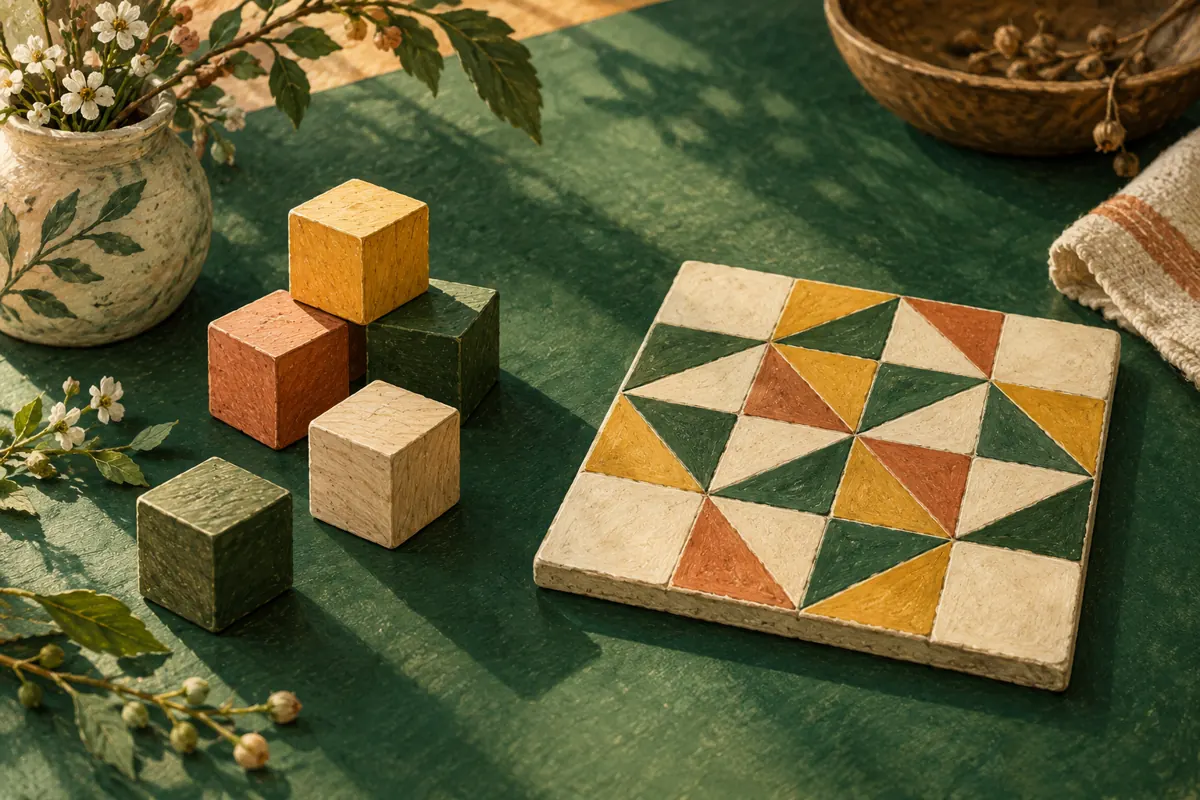
A square array with 6 rows of 6 counters contains 36 counters. A cube with 3 layers, each containing 3 rows of 3 small cubes, contains 27 small cubes. These pictures explain the names square and cube numbers. The exponent tells you the number of repeated factors.
A reference list you can reconstruct
| n | n² | n³ |
|---|---|---|
| 1 | 1 | 1 |
| 2 | 4 | 8 |
| 3 | 9 | 27 |
| 4 | 16 | 64 |
| 5 | 25 | 125 |
| 6 | 36 | 216 |
| 7 | 49 | 343 |
| 8 | 64 | 512 |
| 9 | 81 | 729 |
| 10 | 100 | 1000 |
If a fact is forgotten, reconstruct it from multiplication rather than guessing. For example 12² =12 ×12 =144. The jump from one square to the next is an odd number:8² −7² =64 −49 =15. This is useful for checking a sequence, but always identify the rule rather than assuming every growing sequence contains squares.
Roots reverse the operation
The square root symbol asks for the non-negative number whose square is the given value:√81 =9. A cube root reverses cubing: the cube root of 125 is 5. Notice that solving x² =81 is a different question: if negative values are allowed, both 9 and−9 satisfy it. For a physical side length, use the positive length.
To locate √70, compare neighbouring squares:8² =64 and 9² =81, so√70 lies between 8 and 9. It is not a whole number. No decimal approximation is needed when the question asks only for bounds.
Use units correctly
A square of side 11 cm has area 121 cm²; its perimeter is 44 cm. A cube of edge 4 cm has volume 64 cm³. Square and cube units describe area and volume, while the side or edge itself is a length. Do not attach cm² to the answer when asked for a side.
Original practice
Find 13².
Show answer and explanation
169
13 ×13 =130 +39 =169.
Find 6³.
Show answer and explanation
216
6 ×6 =36, then 36 ×6 =216.
Which is larger:5³ or 11²?
Show answer and explanation
5³
125 is greater than 121 by 4.
A square has area 196 cm². Find its side length.
Show answer and explanation
14 cm
14 ×14 =196; a side is measured in centimetres.
Between which consecutive whole numbers is√110?
Show answer and explanation
10 and 11
10² =100 and 11² =121.
Which of 36,64 and 100 is both a square and a cube of whole numbers?
Show answer and explanation
64
64 =8² =4³. Neither 36 nor 100 is a whole-number cube.
Common traps
Squaring a sum is not the same as squaring each part: (3 +4)² =49, whereas 3² +4² =25. Work inside brackets first. Also,0² =0 and 0³ =0; a list starting at 1 does not mean zero cannot be a square or cube.
What to practise next
Return to the Maths hub, then review number sequences and volume and capacity. Browse the practice directory for further work.
Source and answer checks
The Department for Education programme of study provides the curriculum foundation. School entrance requirements vary. Examples and passages here are original; worked answers were checked against the calculations or the supplied text. No external educator endorsement is claimed.
Ready to practise?
Choose original practice and use the answer explanations to decide what to work on next. These are not official school papers.
Keep reading
More guides relevant to this topic.