11+ Systematic Listing: Find Every Possibility Without Repeats
Organise choices into clear cases so that you can show a list is complete, rather than guessing until no more answers come to mind.
Organise choices into clear cases so that you can show a list is complete, rather than guessing until no more answers come to mind.
This original practice supports preparation for exams taken in 2027. It teaches a transferable maths skill, not an official school paper or a promise about any particular test format. Try each question before revealing its explanation.
Decide what makes two outcomes different
Before listing, ask whether order matters and whether repetition is allowed. Choosing two children for an identical job differs from choosing a captain and deputy. The same pair appears once in the first situation but can fill the two roles in two different ways.
Use short labels and hold one choice fixed while varying the next. This creates cases you can check. If your first-choice cases cover every allowed option and each case is fully explored, your whole list is complete.
Worked example: a lunch choice
There are two sandwiches, cheese(C) and tuna(T), and three fruits, apple(A), pear(P) and banana(B). Choose one sandwich and one fruit. The complete list is CA, CP, CB, TA, TP, TB: six lunches.
Fixing cheese first gives three cases; fixing tuna gives three more. The cases cannot overlap because a lunch cannot have both sandwich choices when the rule says choose one. The count 2×3=6 confirms the organised list.
Worked example: order changes the answer
Three pupils, A, B and C, fill two different roles. The ordered possibilities are AB, AC, BA, BC, CA, CB: six. A pupil cannot fill both roles, so AA, BB and CC are excluded.
If instead two pupils form an unordered pair, AB and BA describe the same pair. The list becomes AB, AC, BC: three. Do not divide every counting answer by two automatically: first understand exactly which outcomes have been repeated.
Zero and repeated digits
Using digits 0, 3, 8 to form two-digit numbers without repetition gives 30, 38, 80, 83. A leading zero does not make a two-digit number, so 03 and 08 are excluded. If repetition is allowed, 33 and 88 join the list, but 00 still is not a two-digit number.
For longer tasks, use a table or branching sketch. Avoid introducing factorial formulas before the choices are understood. For probability, a list can supply the possible outcomes, but only treat them as equally likely when the problem justifies that assumption: see probability.
Original practice: explain your reasoning
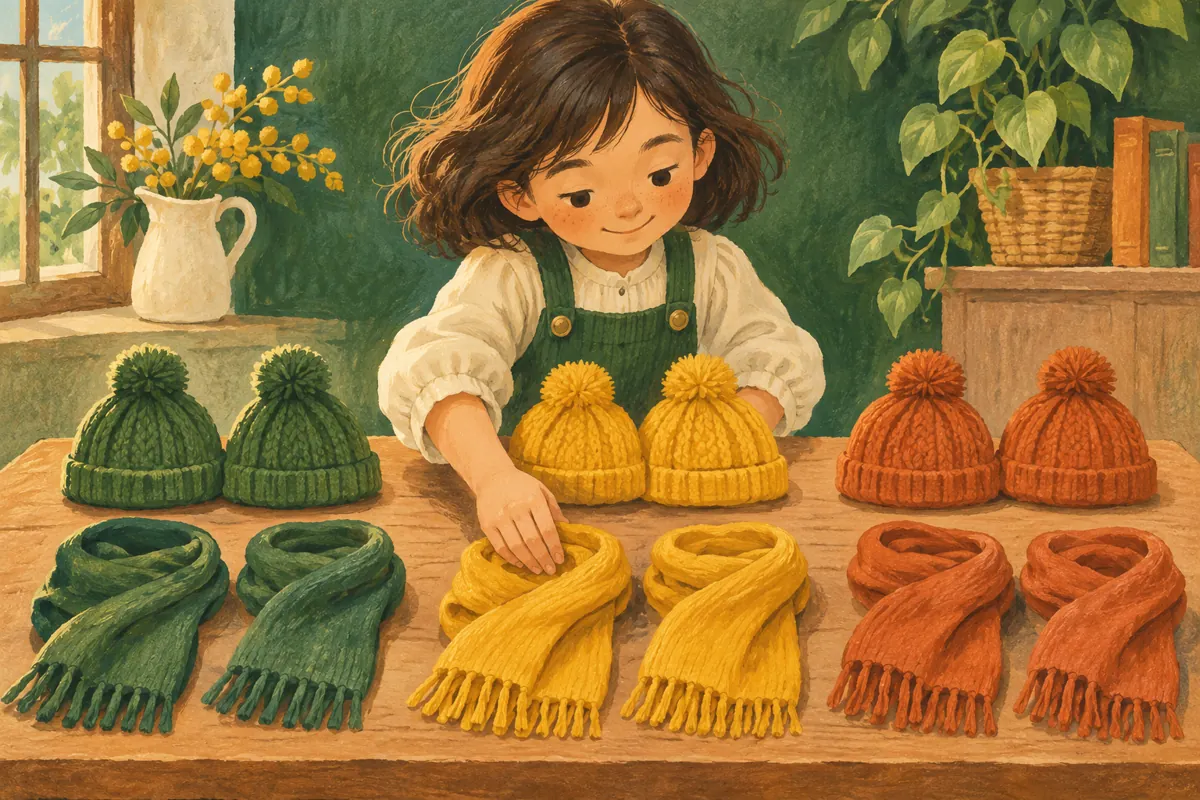
1. Choose one of 3 hats and one of 2 scarves. How many outfits?
Show answer and explanation
6.
Each hat pairs with both scarves, giving three non-overlapping groups of two.
2. Form two-digit numbers from 2, 5, 9 without repeated digits. List them.
Show answer and explanation
25, 29, 52, 59, 92, 95.
Fix each tens digit in turn; there are two remaining units choices for each.
3. Select an unordered pair from A, B, C, D. How many pairs?
Show answer and explanation
6.
AB, AC, AD, BC, BD, CD. Reversed versions do not create new pairs.
4. Using 0, 4, 7 without repetition, how many two-digit numbers are possible?
Show answer and explanation
4.
40, 47, 70, 74. Zero cannot occupy the tens position.
5. A two-symbol code uses X or Y in each position; repetition is allowed. List all codes.
Show answer and explanation
XX, XY, YX, YY.
There are two independent choices per position. Order matters:XY andYX are different codes.
Review the method, then practise again
If an answer differs from yours, identify the first point where your reasoning changed. Was it a definition, a missed condition or a calculation? Correct that step and try the question again without looking. Explain why the corrected answer works; copying the final number is not the same as understanding the method.
Return to the Maths learning hub, then explore working backwards. The paper library offers original printable questions with separate worked answers. Its foundations set is mixed supporting practice, not a worksheet devoted entirely to this topic.
Curriculum reference checked on 4 November 2026: DfE mathematics programme. The examples and questions here are original. No educator endorsement or school affiliation is claimed.
Ready to practise?
Choose original practice and use the answer explanations to decide what to work on next. These are not official school papers.
Keep reading
More guides relevant to this topic.