11+ Venn and Carroll Diagrams: Both, Only and Neither
Sort numbers by two properties, read an original Carroll grid and avoid double counting with eight original explained questions.
A number can satisfy two rules at once. Sorting questions test whether you check both rules, keep the overlap and remember the items satisfying neither. The same information can be organised as a Carroll grid or as four regions in a two-circle Venn diagram.
These original explanations and questions support preparation for 11-plus exams taken in 2027. They are not official papers or a complete school syllabus. Check your target school’s current guidance. Try each question before opening the worked answer.
Start with a complete collection
Use the whole numbers 1 to 12 inclusive. The two properties are “even” and “greater than 7”. Every number must appear once in the table below. A row answers one question and a column answers the other; the cell answers both.
| Numbers 1–12 | Greater than 7 | Not greater than 7 |
|---|---|---|
| Even | 8, 10, 12 | 2, 4, 6 |
| Not even | 9, 11 | 1, 3, 5, 7 |
This is a Carroll diagram: the row labels are a property and its negation, and the columns do the same for the second property. “Not greater than 7” includes 7 itself. “Not even” means odd within this stated collection of whole numbers.
Translate the cells into Venn regions
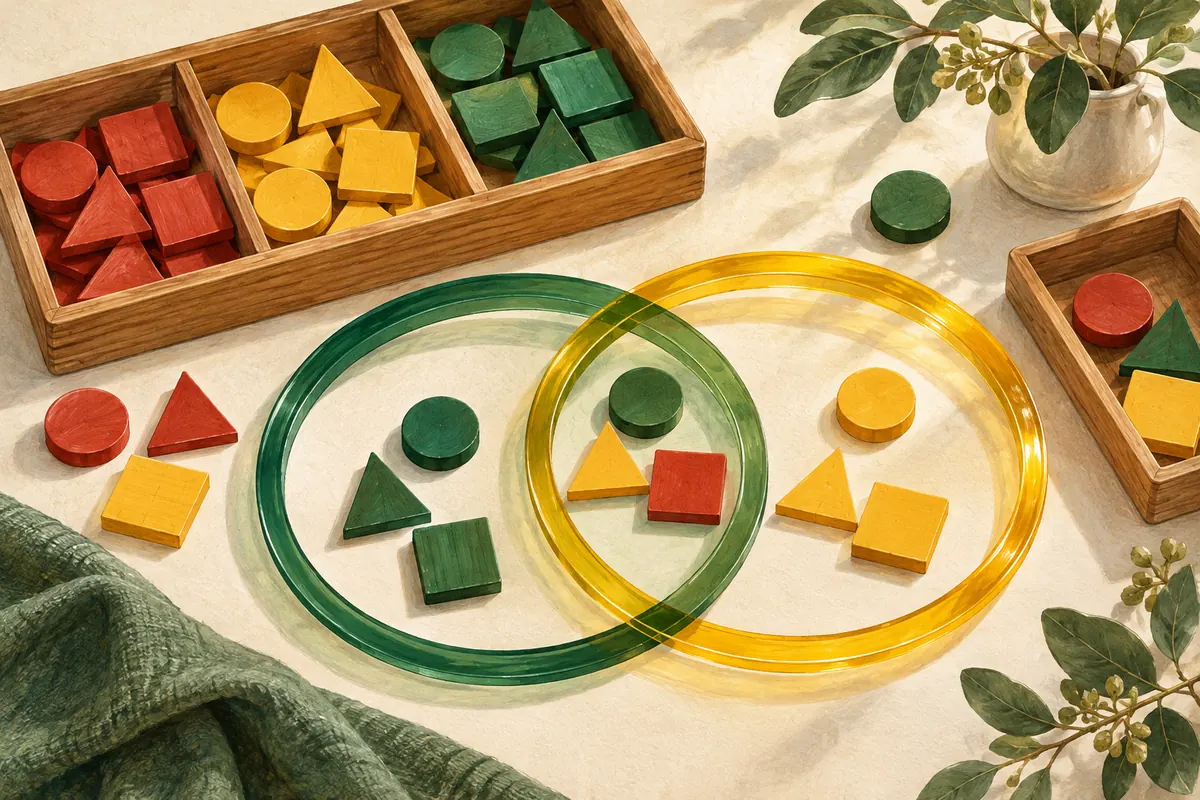
Draw a rectangle for the complete collection, then two overlapping circles labelled Even and Greater than 7. Put 8, 10 and 12 in the overlap because they satisfy both rules. Put 2, 4 and 6 in Even only, 9 and 11 in Greater than 7 only, and 1, 3, 5 and 7 outside both circles but inside the rectangle. The table supplies the complete original data, so no unseen diagram is required to answer the questions.
The Even circle contains six numbers, including its overlap. The Greater than 7 circle contains five. Adding 6 + 5 counts the overlap twice. Count distinct numbers in at least one circle as 6 + 5 − 3 = 8, then add the four outside to recover all twelve.
Read the wording precisely
| Instruction | Regions counted |
|---|---|
| Both | Overlap only |
| Even only | Even but not greater than 7 |
| Exactly one property | The two non-overlapping circle regions |
| At least one property | Both circles, counting overlap once |
| Neither | Outside both circles, within the collection |
The word “or” can be ambiguous in everyday speech, so these questions use “at least one” or “exactly one”. Do not discard the overlap unless the question excludes it. Similarly, a group total such as “likes chess” normally includes people who also like another activity.
Eight original questions
Using the table, list the numbers satisfying both properties.
Show answer and explanation
8, 10, 12
They lie in the Even row and Greater than 7 column.
How many numbers in the table are even only, meaning even but not greater than 7?
Show answer and explanation
3
The relevant numbers are 2, 4 and 6.
How many satisfy neither property?
Show answer and explanation
4
1, 3, 5 and 7 are not even and not greater than 7.
How many satisfy exactly one of the two properties?
Show answer and explanation
5
Even only has 3; greater-than-7 only has 2. Exclude the overlap.
How many satisfy at least one property?
Show answer and explanation
8
Add the distinct regions 3 + 3 + 2, or subtract neither from 12.
In a class of 24, 14 like chess, 11 like music and 6 like both. How many like at least one?
Show answer and explanation
19
14 + 11 − 6 = 19; the overlap was counted in both totals.
In that same class, how many like neither chess nor music?
Show answer and explanation
5
24 − 19 = 5.
For whole numbers 1 to 20 inclusive, how many are multiples of both 3 and 4?
Show answer and explanation
1
The common multiples are multiples of 12; only 12 lies in the collection.
Check all regions together
For two properties, list both, first only, second only and neither. Their counts must add to the stated total, and none can be negative. In the class example, chess only is 8 and music only is 5: 8 + 6 + 5 + 5 = 24. This check catches a forgotten outside region.
Review data interpretation and factors and multiples. Return to the Maths hub or choose original practice.
The AMSI sets and Venn-diagrams teacher module explains set membership and overlap counting.
Sources and scope
The DfE programme of study provides a curriculum foundation, not a prediction of a school’s paper. All examples here are original. No official affiliation or educator endorsement is implied.
Ready to practise?
Choose original practice and use the answer explanations to decide what to work on next. These are not official school papers.
Keep reading
More guides relevant to this topic.