11+ Character Description: Reveal Personality Through Choices
Use an original repair-table scene to practise character through action, dialogue and thought, with model revisions and careful interpretation.
A character becomes interesting through what they choose to do. Hair colour and clothing can help a reader picture someone, but those details do not automatically establish kindness, courage or dishonesty. Give the reader behaviour to interpret, especially when the character faces a small difficulty.
This original writing practice supports preparation for exams taken in 2027. Schools differ in whether and how they assess writing: use the instructions for your chosen route. The models below are possible responses, not official answers or a universal marking scheme.
Build a moment, not a catalogue
Choose a clear situation: something the character wants, an obstacle, and a decision. A child who wants the last spare wheel can keep it, offer it or negotiate. Each action tells the reader more than a list of positive personality words. The situation need not be dramatic to reveal a meaningful choice.
Read the original scene
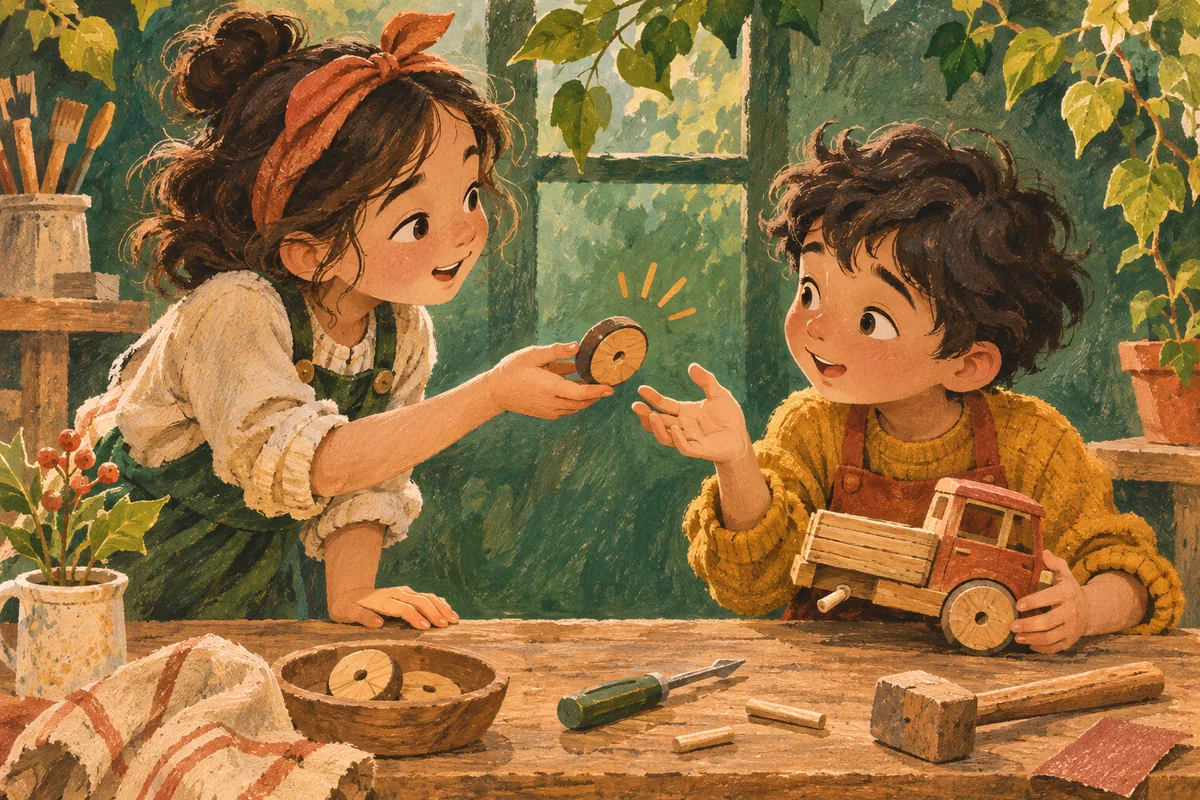
Mira rolled the spare wheel between her fingers. Across the table, Ben pushed his wooden cart; the broken axle dragged along the cloth. Mira looked at her own unfinished model, then set the wheel beside his hand. “Try this one,” she said. Before he could thank her, she bent over the box of spare parts.
Giving up a part she might need suggests generosity. Turning away before thanks could suggest embarrassment, modesty or a wish to get on with the repair. It does not prove one private feeling. If you want readers to know exactly what Mira thinks, you may add a thought from a viewpoint that allows access to it.
Action, speech and thought have different jobs
Action gives something observable. Dialogue lets a character reveal or conceal an intention. Thought gives direct access to an inner response when the narration permits it. “She hoped he would not notice her disappointment” is different from “She pushed the box away”: the first states a feeling, the second invites an inference.
Showing is useful, but telling is not forbidden. A brief statement can move the story through an unimportant interval. Expand the moment that matters; summarise what the reader does not need to watch in detail. Otherwise every simple action can become slow and over-described.
A worked revision
Flat draft: “Owen was impatient. He wanted to start. He was very impatient with everyone.” Revision: “Owen had already uncapped the glue. While the others searched for their pieces, he tapped the nozzle against the table. ‘Are we building this today?’”
The repeated description has become an action and a line of speech. The reader can infer impatience without being told three times. The revision also creates a risk: glue could spill while Owen rushes. That gives the writer a useful next event grounded in the scene.
Original exercises
1. Which action most strongly suggests that Mira is generous?
Show answer and explanation
She places the spare wheel beside Ben’s hand despite having her own unfinished model.
The possible personal cost makes the choice meaningful. The inference comes from action and context, not appearance.
2. Must Mira’s final movement mean that she dislikes Ben?
Show answer and explanation
No. Several explanations fit, including embarrassment or returning to work.
A single gesture rarely proves a private motive. A continuation can develop one interpretation if it remains coherent.
3. Add one sentence that reveals Mira’s disappointment while keeping the narrator close to her thoughts.
Show answer and explanation
Model: She had wanted that wheel for her own model, but Ben’s smile made the empty axle easier to bear.
The sentence supplies an inner response and connects it to the existing choice. It does not contradict her outward generosity.
4. Show that a character is careful using an action rather than the word careful.
Show answer and explanation
Model: Sam tested the knot twice before passing the handle to his little brother.
Checking the knot makes caution visible in a specific situation. Other actions with a clear purpose can work.
A fresh writing task
At a craft stall, a child receives too much change. Write the moment they notice and decide what to do. Include an action and a short line of speech. Afterwards, ask a reader what trait they infer and which exact words led them there. If their inference differs from your intention, revise the evidence rather than adding more labels.
Write, compare, improve
Attempt the task on paper before revealing the model. Compare the choices rather than copying the wording. Underline one effective detail in your own response, identify one unclear sentence, then rewrite that sentence. Keep both versions so you can explain what changed. A different response can work equally well when it meets the instruction.
Return to the English learning hub and the creative-writing overview. Continue with story continuation. For written-answer review, use the evidence lesson. The paper library includes an original English punctuation set with separate worked answers; it is supporting practice, not an automatic composition marker.
Teaching references checked on 3 November 2026: DfE English programme and CSSE sample writing criteria. These support attention to purpose, language and accuracy; they do not confirm a school’s 2027 paper. All passages and exercises here are original.
Ready to practise?
Choose original practice and use the answer explanations to decide what to work on next. These are not official school papers.
Keep reading
More guides relevant to this topic.