11+ Describing Settings: Create Mood with Precise Details
Compare two original greenhouse descriptions, choose details for a mood and practise focused setting paragraphs with model responses.
A setting description guides the reader’s attention. It can make the same place feel welcoming, neglected or uncertain, depending on what the viewpoint character notices. The aim is not to name everything visible. Choose details that work together and make the place understandable.
This original writing practice supports preparation for exams taken in 2027. Schools differ in whether and how they assess writing: use the instructions for your chosen route. The models below are possible responses, not official answers or a universal marking scheme.
Keep a viewpoint and a purpose
Before drafting, decide where the observer stands and what mood the task requires. Someone outside a greenhouse can see wet glass and blurred leaves; they cannot describe the exact texture of a leaf inside without entering or remembering it. A consistent viewpoint helps the reader follow the scene.
Use senses when they contribute something. The scrape of a loose hinge may suggest neglect; a list of unrelated smells, colours and tastes may distract. You do not need to force all five senses into every paragraph. Description can include small movements without becoming a complete adventure.
One place, two treatments
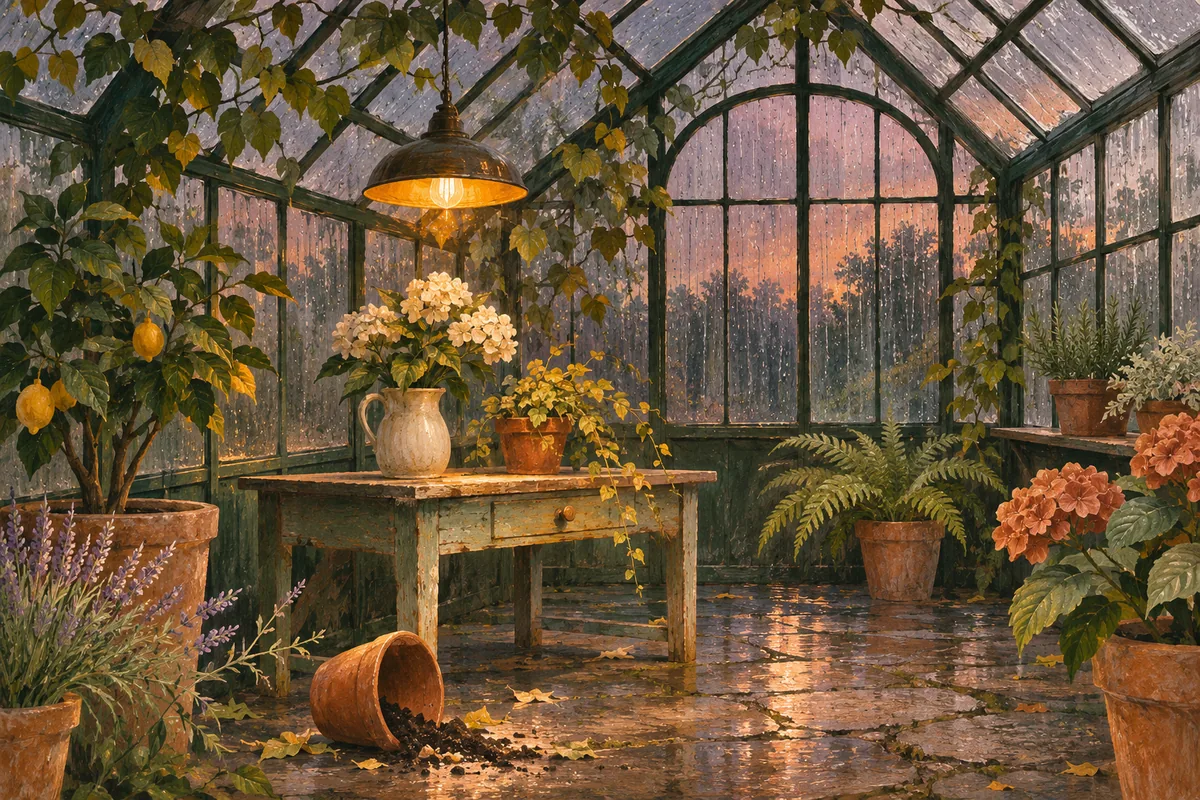
Original calm version: Rain tapped the greenhouse roof. Beneath the bench, dry seed trays fitted neatly inside one another. A lamp warmed the leaves nearest the door, and the scent of damp soil rose as Arun loosened the latch.
Original uneasy version: Rain ticked against the greenhouse roof. Beneath the bench, a pot lay on its side, its soil scattered across the tiles. The lamp was still burning. Arun touched the latch; it swung away from his hand.
The weather and location remain similar. In the second version, the fallen pot and unexpectedly loose latch suggest that something has disturbed the scene. The text does not prove who was there or what happened. The lamp’s short sentence draws attention to a detail that now feels unusual.
Revise for purpose, not decoration
A vague draft might say, “The greenhouse was strange and there were lots of things.” A more useful revision chooses an object and an action: “A torn label fluttered from the only empty pot.” The revision creates a specific question. It does not need a string of elaborate adjectives to do so.
Read every comparison literally before keeping it. If leaves are described as whispering, what sound suggests that? If a place is described as both silent and full of roaring machinery, explain the change or choose one coherent impression. Figurative language should sharpen the scene rather than make its basic facts difficult to picture.
Original exercises
1. Which two details in the uneasy version suggest disturbance?
Show answer and explanation
The overturned pot with scattered soil, and the latch swinging away.
Both are concrete changes or irregularities. Rain alone does not show that anything has disturbed the greenhouse.
2. Does the passage prove that a burglar entered?
Show answer and explanation
No. That is one possible invention for a continuation, not an established fact.
The description gives clues without identifying a cause. Separate what is stated from what a writer might invent next.
3. Rewrite “The room was neglected” using one object and an action.
Show answer and explanation
Model: Dust lifted from the chair when I brushed its arm.
The detail suggests disuse through something observable. Other precise details can work; the exact wording is not compulsory.
4. Describe the greenhouse as welcoming in two sentences without using welcoming or nice.
Show answer and explanation
Model: The open door released a breath of warm, earthy air. Someone had left a clean stool beside the tray of seedlings.
Warmth and a place to sit make the scene inviting. The details support one mood without listing every object.
Try a fresh paragraph
Describe a small harbour before the boats leave, making it feel expectant rather than frightening. Establish where the observer is, select a sound and one movement, then end on a detail that holds the mood. Review whether an unfamiliar reader could picture the place and explain which words create anticipation.
Write, compare, improve
Attempt the task on paper before revealing the model. Compare the choices rather than copying the wording. Underline one effective detail in your own response, identify one unclear sentence, then rewrite that sentence. Keep both versions so you can explain what changed. A different response can work equally well when it meets the instruction.
Return to the English learning hub and the creative-writing overview. Continue with character through action. For written-answer review, use the evidence lesson. The paper library includes an original English punctuation set with separate worked answers; it is supporting practice, not an automatic composition marker.
Teaching references checked on 3 November 2026: DfE English programme and CSSE sample writing criteria. These support attention to purpose, language and accuracy; they do not confirm a school’s 2027 paper. All passages and exercises here are original.
Ready to practise?
Choose original practice and use the answer explanations to decide what to work on next. These are not official school papers.
Keep reading
More guides relevant to this topic.