11+ Story Endings: Resolve the Problem Without Rushing
Compare two original endings to a kite story, connect consequences to character choices and practise a final paragraph with model answers.
An ending should respond to the story the reader has been following. It does not need a spectacular surprise. A small decision, consequence or final image can be satisfying when it grows from the main event. Decide what the story has made the reader want to know before trying to close it.
This original writing practice supports preparation for exams taken in 2027. Schools differ in whether and how they assess writing: use the instructions for your chosen route. The models below are possible responses, not official answers or a universal marking scheme.
Find the central question
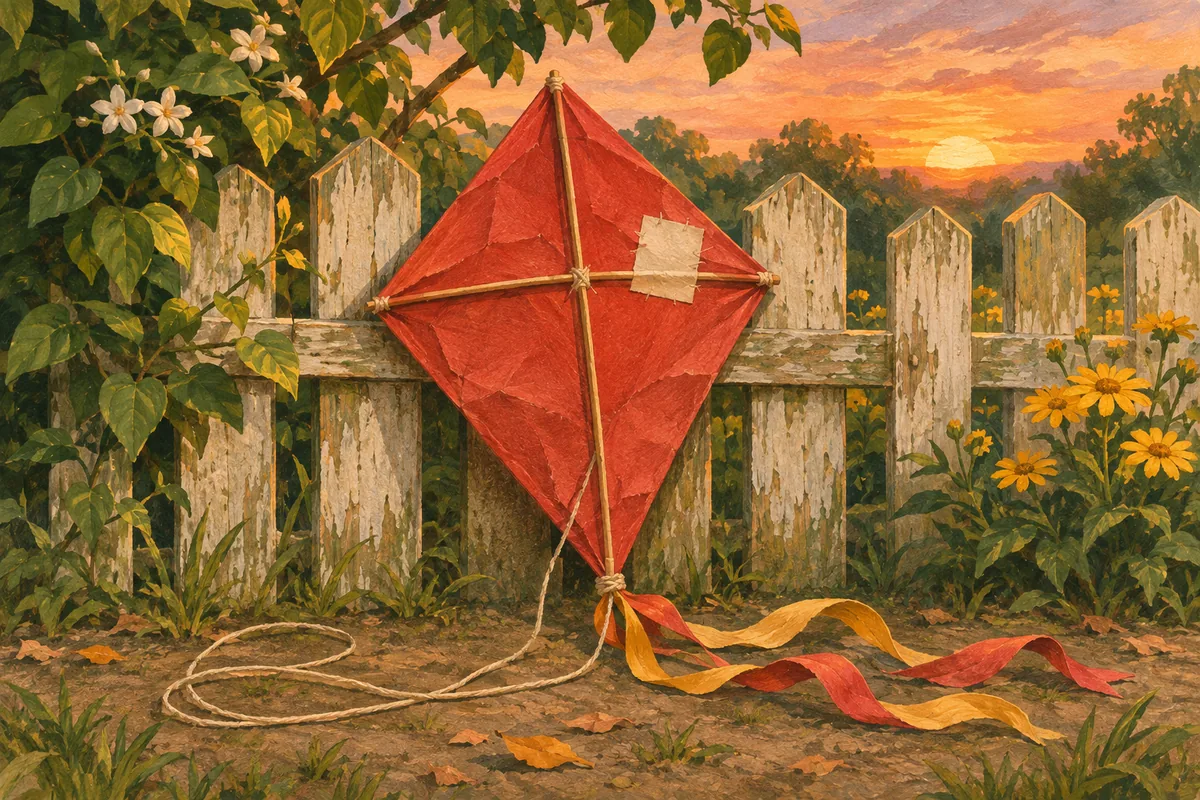
Original story situation: Leo borrowed his cousin’s red kite without asking. It caught on a thorn and tore. He spent the afternoon repairing the paper, but the patch was obvious. Now his cousin was coming through the garden gate.
The central question is not simply whether the kite flies. Leo has concealed a choice that damaged someone else’s possession. An ending that describes a beautiful sunset while avoiding the cousin may close the scenery but leave the important action untouched.
Two possible endings
Ending A: Leo held out the kite before his cousin could ask. “I borrowed it. I’m sorry.” His cousin ran a finger around the patch. For a moment neither spoke. Then she took the other end of the string. “Next time, ask first.”
Ending B: Leo carried the kite to the gate. “I need to tell you something,” he said. His cousin listened without touching the string. When he finished, she took the kite home. The patch was still bright red against the fading garden.
Both endings bring Leo to an honest admission. A offers a practical sign of reconciliation, though permission still matters. B leaves the relationship less settled but completes Leo’s decision to tell the truth. An ending can leave uncertainty without stopping before the central action happens.
Earn the outcome
If a helpful tool or character solves the problem, establish it earlier or introduce it plausibly. A stranger appearing in the final sentence with a perfect replacement kite would remove Leo’s difficulty without making him face it. That is not always impossible fiction, but it would weaken this particular story’s focus.
Likewise, “It was all a dream” is not forbidden in every story. Here it would erase the consequence that makes Leo’s decision matter. Ask what the device contributes. If its only function is to escape a difficult ending, choose an outcome connected to the character’s actions instead.
Use a final detail deliberately
A repeated object can carry a changed meaning. At first, the patch might represent something Leo wants to hide. At the end, it can remain visible after he tells the truth. You do not need to explain the moral in a separate lecture. Let the reader understand what changed through the scene.
Original exercises
1. What question should this story’s ending address?
Show answer and explanation
Whether Leo admits borrowing and damaging the kite, and what follows.
The secret and its consequence drive the situation. Flight alone would not settle that problem.
2. Which detail in ending A suggests a possible repair to the relationship?
Show answer and explanation
The cousin takes the other end of the string.
The shared action suggests they may use the kite together. It does not prove that every feeling of annoyance has disappeared.
3. Is ending B unfinished simply because it is less cheerful?
Show answer and explanation
No. Leo makes the central admission, while the cousin’s longer-term response remains open.
A complete scene can retain emotional uncertainty. The important distinction is between deliberate uncertainty and abandoning the action.
4. Write a different final two sentences after Leo apologises.
Show answer and explanation
Model: His cousin placed the kite between them. Together, they pressed down the lifting corner of the patch.
The shared repair develops the existing object and relationship. Many other consequences are possible if they follow coherently from the apology.
Practise an ending before a whole story
Invent a situation where a child loses a borrowed object, then write two endings: one in which the object is found, and one in which it is not. In both, make the child respond to the responsibility. Compare which outcome reveals more about the character. This exercise is about choices, not a required exam formula.
Write, compare, improve
Attempt the task on paper before revealing the model. Compare the choices rather than copying the wording. Underline one effective detail in your own response, identify one unclear sentence, then rewrite that sentence. Keep both versions so you can explain what changed. A different response can work equally well when it meets the instruction.
Return to the English learning hub and the creative-writing overview. Continue with character through choices. For written-answer review, use the evidence lesson. The paper library includes an original English punctuation set with separate worked answers; it is supporting practice, not an automatic composition marker.
Teaching references checked on 3 November 2026: DfE English programme and CSSE sample writing criteria. These support attention to purpose, language and accuracy; they do not confirm a school’s 2027 paper. All passages and exercises here are original.
Ready to practise?
Choose original practice and use the answer explanations to decide what to work on next. These are not official school papers.